
Construction AI Has a Context Problem. We Are Fixing It.
Construction AI Has a Context Problem. The Drawing Can Fix It.
Construction does not have a data shortage. It has a context problem.
Walk onto almost any commercial project and you will find drawings, specifications, RFIs, submittals, photos, schedules, punch lists, field notes, emails, daily logs, and spreadsheets.
The information exists. The problem is that much of it does not know how it relates to the building.
A photo lives in a photo folder. An RFI lives in an RFI log. A punch item lives in another module. A schedule exists somewhere else. The drawing is often treated as one more file in the project.
Humans are left to connect the dots.
FrameTrace solves that gap by using the drawing as the spatial layer that connects project information around the physical building.
The drawing is more than a PDF
Construction teams already have a shared interface for understanding the job: the drawing set.
When someone says:
"The door into 406."
The team understands the reference because the room, wall, door, and surrounding conditions exist spatially on the plans.
FrameTrace turns that spatial context into software.
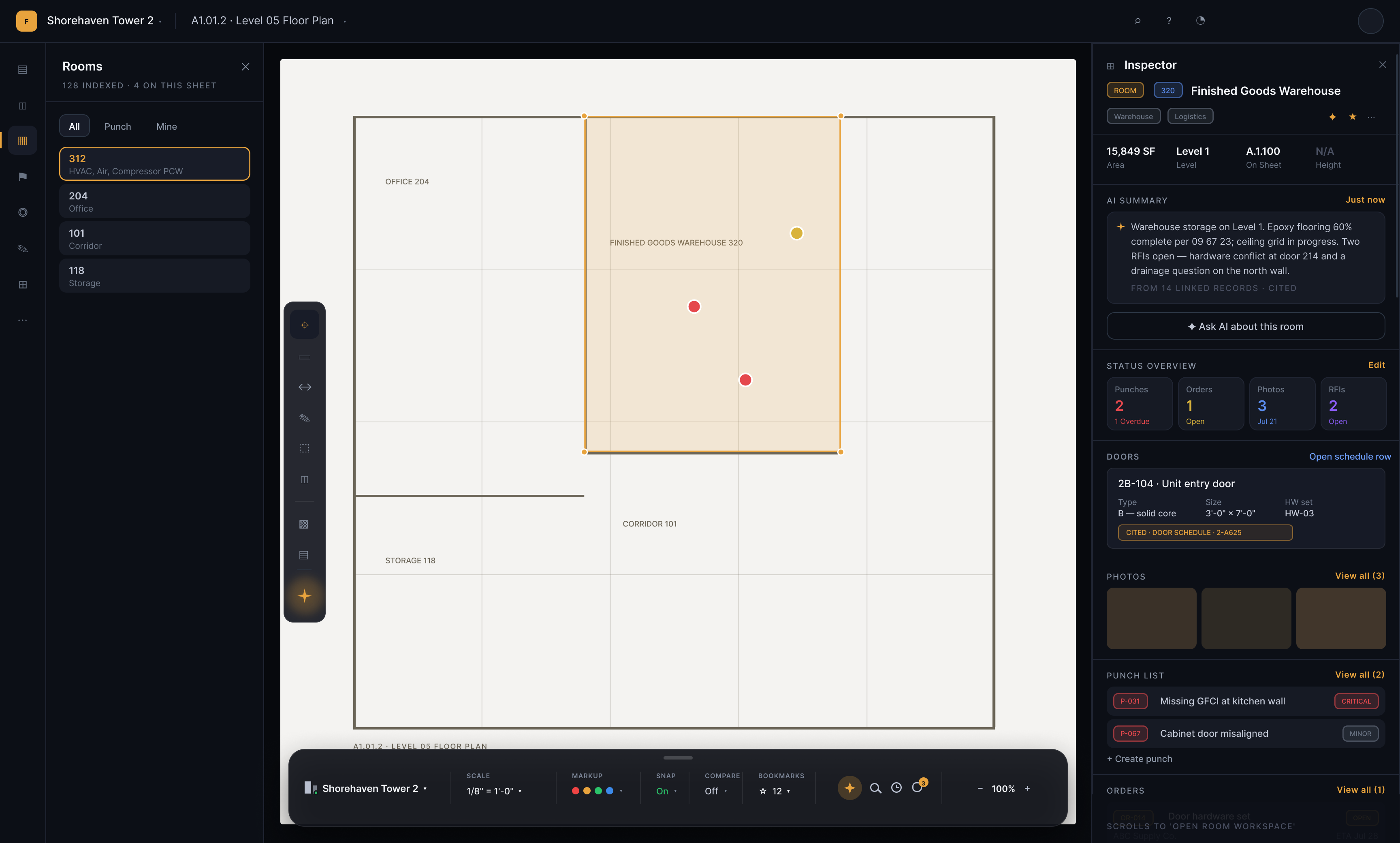
Instead of treating a drawing as a flat PDF, FrameTrace understands the structure inside it: sheets, rooms, doors, keynotes, dimensions, callouts, and relationships across the drawing set.
Those objects become anchors for project information.
A punch item is not just an item in a list. It is a punch item in Room 406, at a specific point on the drawing.
A photo is not just IMG_2849.jpg. It is a photo of a condition in a known location.
An RFI is not just RFI-037. It can be connected to the part of the building it affects.
The building becomes the index
Traditional construction software often starts with modules. Where is the RFI? Open the RFI tool. Where is the photo? Open Photos. Where is the punch item? Open Punch.
FrameTrace starts with a different question: where in the building are you working?
From there, the team can understand what is happening around that physical location.
What is specified here? What records are connected here? What is still open? What has been photographed? What quantity is associated with this room? What changed?
The drawing becomes the common interface between the field, the project data, and the AI.
Why this matters for AI
AI becomes significantly more useful when it understands relationships instead of only text.
Summarizing 200 RFIs is helpful. Understanding that one RFI, a door, a field photo, a detail, and a scheduled activity all relate to the same physical condition is more powerful.
FrameTrace creates that connected context.
Documents become structured project knowledge. Project records attach to real locations. User questions inherit spatial context. Quantities remain tied to the geometry and documents that produced them.
That gives AI a better foundation for answering project questions and helping users take the next action.
What this looks like in practice
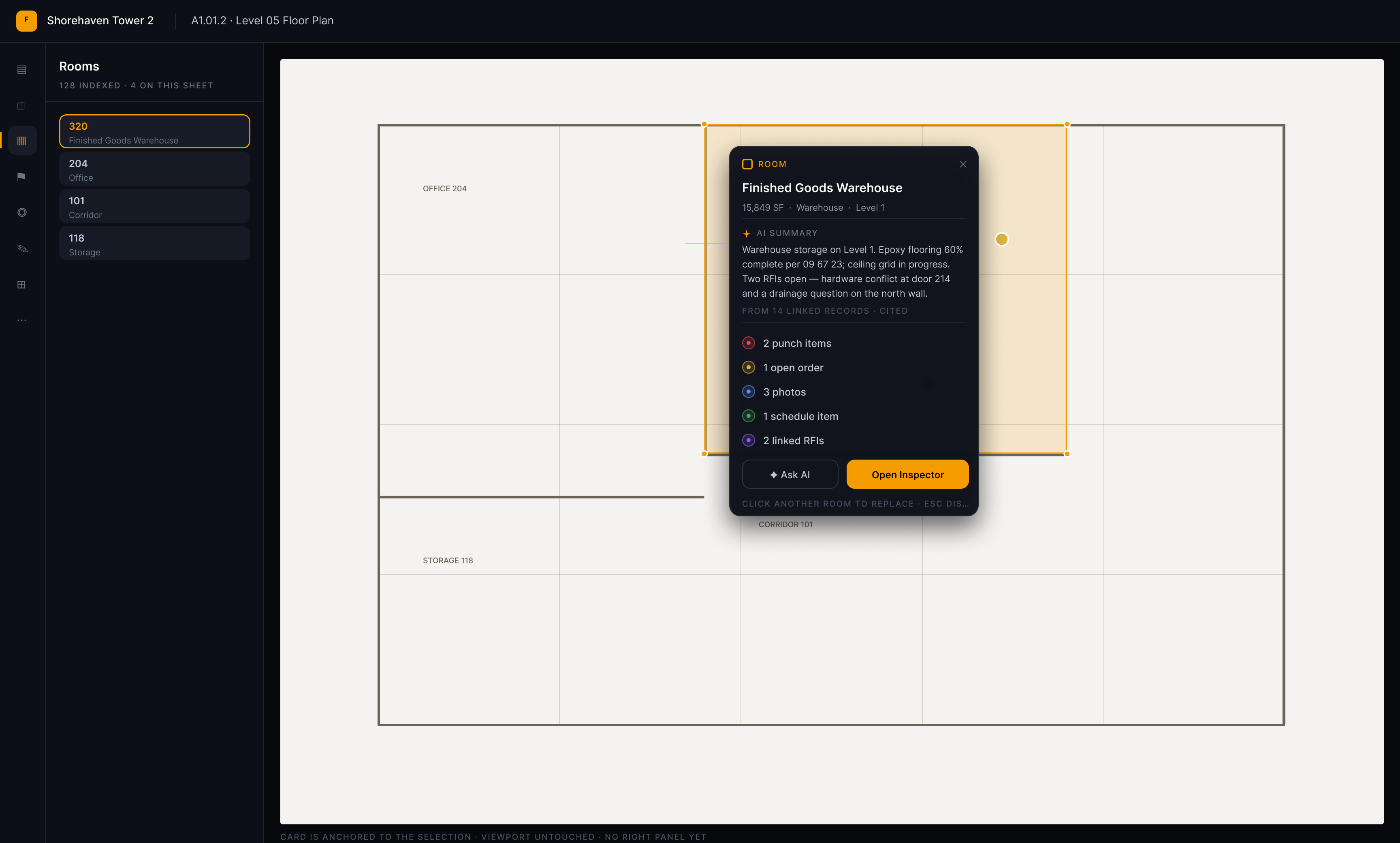
A superintendent opens Room 406 in FrameTrace.
Instead of searching multiple systems, the room becomes the starting point for understanding the work there. The user can review connected project information, ask a question about the drawings, verify the answer at its source, capture a field condition, or measure the space without abandoning the context of the room.
That is the difference between storing project information and understanding how the information relates.
The bigger shift
The next generation of construction software will not win by simply storing more files.
It will make the information already on the project easier to understand, verify, connect, and act on.
FrameTrace does that by starting with the document every construction team already depends on: the drawing.
The drawing is not another file inside FrameTrace. It is the spatial layer connecting the project together.
Explore more blogs




.png)
.jpg)